 IranHistoric attraction; Monumental gateway
Ali Qapu Gate of Qazvin
The monumental surviving entrance to the Safavid royal precinct at the head of Sepah Street.
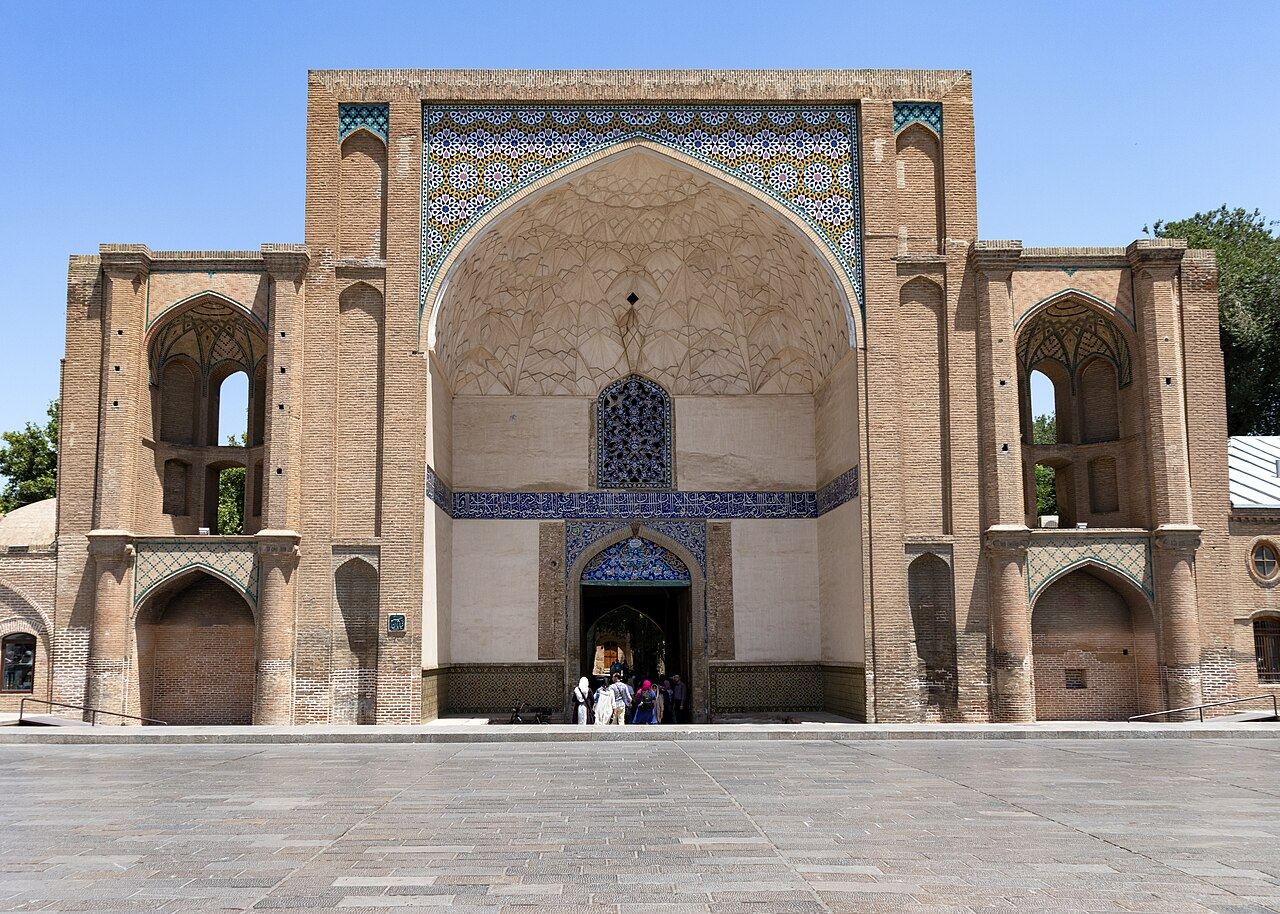
The gate’s importance begins with its position. It was not simply an opening in a wall, nor an ordinary passage between streets. It was a formal threshold between the public city and the controlled world of the court. From the street, its elevated arch and broad composition announced that a different kind of space lay beyond. Movement through the entrance could therefore carry a ceremonial meaning: entering the gate meant crossing into the domain of government, royal residence and official display. Its location at the head of Sepah Street also reveals how the Safavid planners connected the court with the city’s principal urban movement.
Stand before the façade and first observe the large central arch. Its height gives the gate a strong vertical presence, while the surrounding masonry frames the opening as the visual centre of the monument. The design is both practical and symbolic. It had to accommodate passage, but it also had to make authority visible. The gate’s proportions draw the eye upward and make the entrance legible from the street. Even without seeing the vanished buildings behind it, the surviving structure suggests the scale and hierarchy of the precinct it once controlled.
One of the most important details is the inscription in the upper part of the façade. It is executed in mosaic tile and written in thuluth, a calligraphic style recognized for its large, flowing letters and monumental character. The inscription is associated with Ali Reza Abbasi, the celebrated calligrapher of the Safavid court. Here, writing is not an accessory placed beside architecture; it is part of the architecture’s visual order. The sweeping forms of the letters balance the geometric structure of the portal and connect the building with the religious, literary and courtly culture of the Safavid period.
Look closely at the surviving tilework and at the way small pieces of coloured ceramic are set beside brick and plaster. Mosaic tile allowed artisans to create precise borders, bands and patterned surfaces while introducing intense colour into the entrance. Among the decorative elements associated with the gate are two confronting lions with a sun between them. Such imagery belongs to the symbolic vocabulary of Iranian royal and decorative art. The remaining fragments should also be read as evidence of time. Differences in colour, surface texture and preservation show where the monument has endured, where it has been repaired and where parts of its original decorative programme have disappeared.
The gate was altered after the Safavid period. Repairs and additions were made during the Qajar era, and later administrative and security uses affected parts of the structure during the Pahlavi period. Some later markings were added to the upper façade and subsequently removed, leaving the monument with visible layers from different historical periods. These changes do not erase its Safavid identity; instead, they record the continuing reuse of a structure that remained important within Qazvin’s urban life.
Ali Qapu Gate is therefore more than a decorated entrance. It is a surviving fragment of a royal city, a statement of Safavid authority, and a point where architecture organized movement between government and everyday urban life. The arch, inscription, mosaic tiles and position beside Sepah Street allow the vanished دولتخانه to be understood through one concentrated monument. What remains is only the threshold, but that threshold preserves the memory of Qazvin as a capital, the skill of Safavid artisans and the successive transformations that shaped the city around it.