 IranNatural attraction; Valley and rock formations
Andaj Rock Valley
A rugged valley of sculpted cliffs and river scenery in the Alamut mountains.
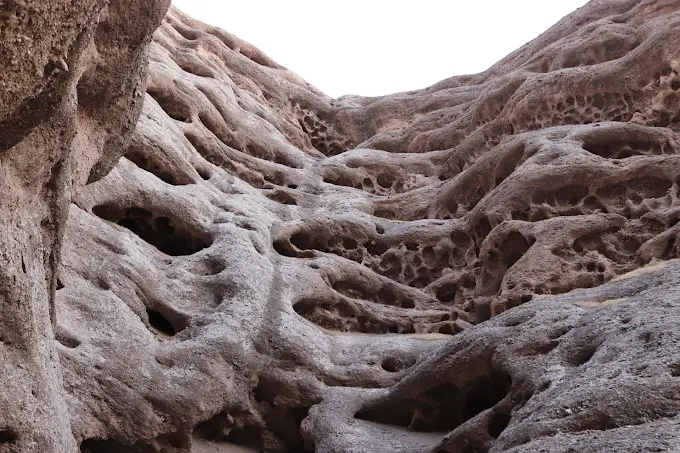
The most immediate impression comes from the scale and irregularity of the rock walls. Their surfaces are broken by vertical grooves, shallow channels, recesses and uneven shelves. These forms were produced gradually by natural processes rather than by a single visible event. Rainwater enters cracks and follows lines of weakness, while freezing and thawing widen those openings. Temperature changes, wind and the repeated movement of water continue to alter exposed surfaces. The result is a series of shapes that may resemble towers, ribs, openings or sculpted faces, although each form remains part of the natural cliff. Close observation reveals that different sections of the same wall have different textures, colors and degrees of erosion.
Water gives the valley a second visual structure. Along the lower parts of the ravine and between the rock walls, the course of Andaj River creates darker, more humid surfaces than those on the exposed slopes. Stones near the channel may be smoother or differently colored, while shallow depressions can collect moisture after rain or seasonal flow. The relationship between water and rock is especially clear where the channel narrows and the walls rise more sharply. Even when the flow is modest, the valley retains evidence of water’s long-term role in cutting, carrying and reshaping material.
Vegetation follows the same variations in moisture, shelter and elevation. Small plants and mountain-adapted shrubs occupy breaks in the slope, pockets of soil and protected cracks. Areas near the watercourse can appear greener than the dry faces above them. The contrast is not decorative alone; it shows how the valley’s geology controls the distribution of living growth. Exposed rock, shaded recesses, loose sediment and damp ground each provide different conditions within a relatively compact space.
Andaj belongs to the wider physical geography of Alamut, a mountainous region whose valleys and rivers connect scattered settlements. At the village and valley scale, the setting is defined by the close relationship between human habitation, steep terrain and available water. From within the valley, the landscape is read vertically: the channel at the lowest level, vegetation along protected ground, and cliff faces rising toward the open mountain sky.
Some passages contain sloping, wet or unstable surfaces, and conditions can change after rainfall. Loose stones, increased flow and narrow gaps may make movement difficult. The cliffs should therefore be viewed from stable, recognizable routes, while technical canyon travel requires appropriate equipment and local expertise. The essential character of Andaj Rock Valley is found in its natural continuity: water at the base, weather-shaped stone above, and a mountain environment that remains legible in every crack, ledge and change of vegetation.