 IranNatural attraction; Forest park
Barajin Forest Park
A large recreational landscape north of Qazvin with city views and open green space.
The park’s vegetation combines local growth with trees and shrubs planted within the grounds. Among the planted species reported in the park are different cypresses, black pine, mulberry, acacia, maple, juniper, Judas tree and lilac. Shrubs such as barberry, sumac, tree mallow and ornamental flowering plants can also be seen in landscaped areas. On the more natural-looking slopes, wild plants including licorice, wild chamomile, wormwood and edible mountain herbs appear among the grasses. The contrast is easy to read on the ground: straight lines and repeated spacing reveal planned planting, while scattered herbs and uneven growth follow the natural soil and slope. Together, these two forms of vegetation give Barajin the character of a forest park rather than a purely natural woodland.
Walking routes, cycling paths, grassy areas, sitting shelters, play spaces and other recreational features are distributed through the park. Some sections are open to the sun and emphasize the broad landscape, while wooded sections create shade and a closer, more enclosed view. Within the same parkland, visitors may encounter features such as an amusement area, an open-air cinema, a recreational sled track and spaces associated with outdoor exercise. These are not separate destinations replacing the forest park; they are functional layers within Barajin. Their placement among trees, slopes and open clearings shows how the site has been shaped for both everyday recreation and contact with an elevated landscape.
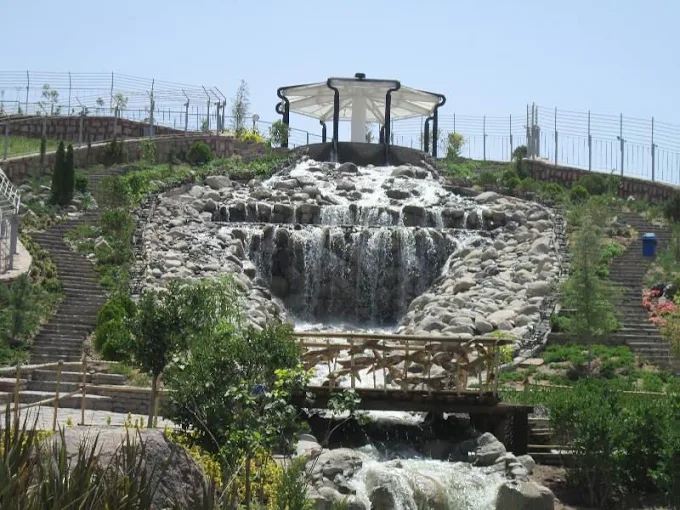
The Nature Village is one of the recognizable components inside the park. Its spaces are used for displaying and caring for groups of animals, birds and reptiles, and visible elements include a pigeon house, deer enclosures, a buffalo farm, a reptile garden, a pond, a waterfall, an aquarium and a rural-style house. An open-air amphitheatre and educational display areas add another dimension to the park, connecting recreation with observation of animal life. The arrangement of these features can be read as a sequence of different environments: open planted ground, constructed shelters, water features and designated animal spaces. All of them remain part of the larger Barajin Forest Park identity.
Barajin’s cultural meaning for Qazvin comes from the way it brings a spacious hillside landscape into the city’s daily life. Its importance is not based on one monument or one historic building, but on the experience of moving through a large public landscape where views, trees, recreation and environmental display coexist. Spring reveals more of the wild grasses and herbs; summer makes the shaded woodland especially noticeable; and autumn places changing foliage against the city skyline. What stands before you is neither untouched wilderness nor a formal historic garden. It is a planted and managed forest park whose slopes, vegetation, recreational structures and animal-display spaces have become a single, recognizable part of Qazvin.