 IranHistoric attraction; Caravanserai
Saad al-Saltaneh Caravanserai
A monumental Qajar commercial caravanserai in the historic centre of Qazvin.
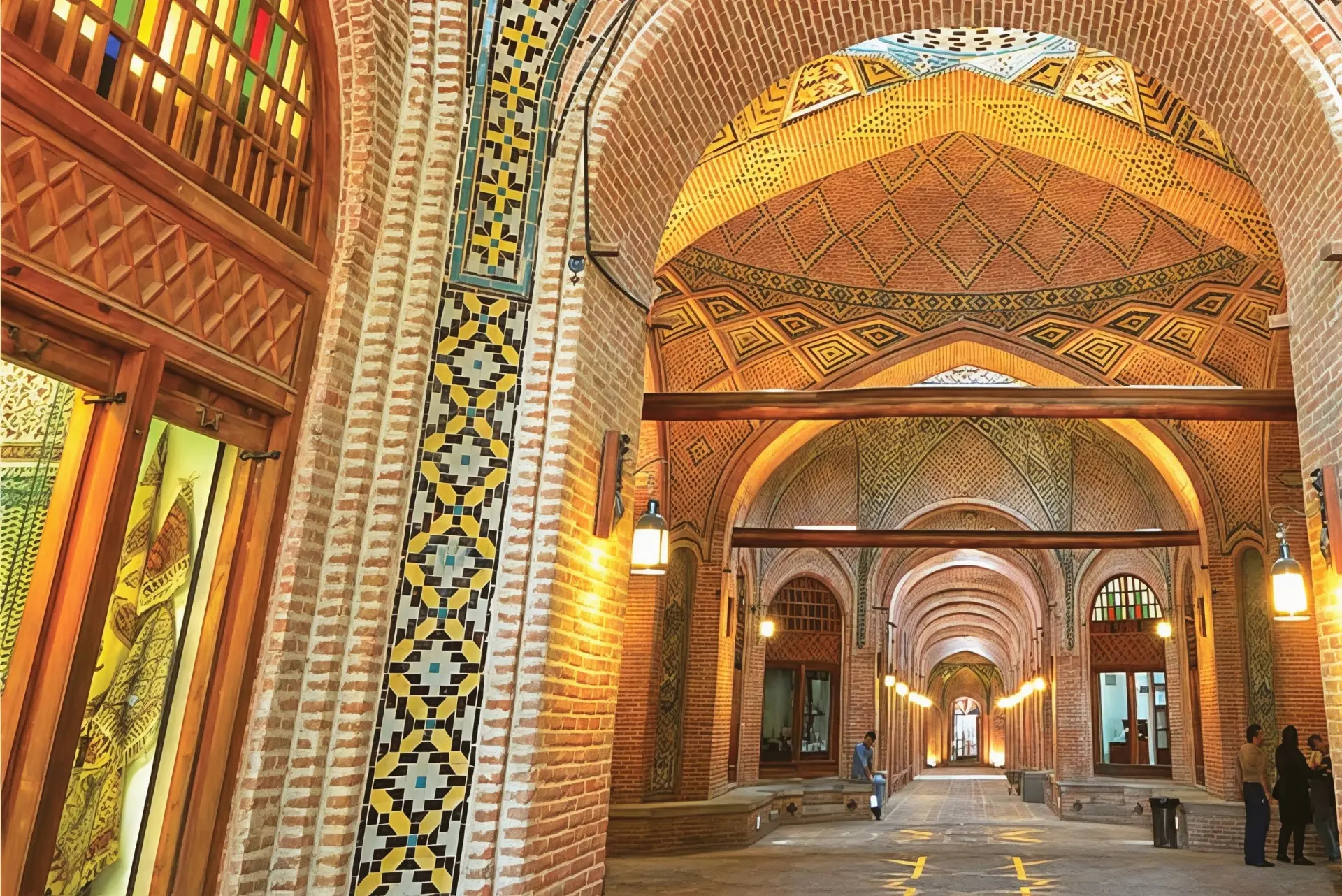
The main entrance from Imam Khomeini Street leads into a hashti, or vestibule, that forms the first architectural threshold. Brickwork and tile decoration cover this transitional space, while a traditional Yazdi-bandi ceiling creates a patterned surface overhead. The hashti separates the direct openness of the street from the more inward-looking organization of the caravanserai. Light becomes more controlled, footsteps gain a distinct echo, and the route divides toward courtyards and covered passages. The east–west axis leads toward the Qeisariyeh Passage, while the north–south axis is associated with the Ghahramani route. These axes are not merely directions on a plan; they organize the visitor’s experience through changes in scale, brightness, sound and movement.
The Sa’d al-Saltaneh Courtyard is the largest open court and the spatial centre of the complex. Rooms and chambers line all four sides, many raised slightly above the courtyard floor. This modest elevation helped separate commercial interiors from the movement of animals, porters and customers, while also giving the chambers a clear visual position around the open space. Look at the repeated arches, the small iwans before the rooms, the brick frames around the openings and the continuous rhythm of the façades. The contrast between the open court and its shaded edges reveals the practical hierarchy of the caravanserai: people could pause, goods could be displayed or moved, and rooms remained close to the circulation routes without opening directly onto the street.
At the meeting point of the principal routes stands the Central Chaharsuq, a domed hall that provides one of the most memorable spaces in the caravanserai. Its large decorated dome is accompanied by four semi-domes, and yellow and turquoise tiles introduce colour into the predominantly brick structure. Three inscriptions record the completion of the building and the names of its architects or builders. Notice how the acoustics change beneath the high curved surfaces. Voices and footsteps linger differently here than in the narrower passages, making the chaharsuq both a functional junction and a dramatic transition from linear movement to a central architectural volume.
The named courtyards reveal the complex’s distinct economic functions. Negar al-Saltaneh Courtyard, in the western section, was primarily associated with receiving, sorting, storing and moving merchandise; historical descriptions note that caravans did not remain there overnight after unloading. Sa’dieh Courtyard is distinguished by decorative brickwork and tile, with the Sa’dieh Bathhouse beside it. Shotor-Khan Courtyard served as a working yard where caravans entered and goods were unloaded, while the large area known as the Hundred Columns to the north suggests the scale of logistical activity. Beheshtian Courtyard combines accommodation and essential infrastructure, containing two large halls, two iwans, eight rooms and a water reservoir. Ghahramani Courtyard is more secluded, with no direct exterior access and rooms set at courtyard level, revealing the deeper layers of controlled circulation within the complex.
Rasteh-ye Vazir, a covered commercial passage with approximately forty-four shops, demonstrates that Saad al-Saltaneh was not simply a place for travellers to sleep. It connected Negar al-Saltaneh Courtyard with the wider bazaar network. Observe the continuous shopfronts, the roofline and the filtered light that guides movement between market and courtyard. Along the Qeisariyeh Passage, listen again to the shift in sound as the route approaches the open courts. Across the complex, shaped brick, geometric ceiling patterns, vaulted openings, domes, coloured tiles, wooden doors and changing shadows reward close attention. Saad al-Saltaneh is significant because its architecture preserves an entire urban system in one connected structure: residence, storage, trade, services and caravan movement were arranged as parts of a single commercial world.
Areas
♪
Introduction and history
Open area ←♪
Key features and highlights
Open area ←♪
Visitor guide and practical advice
Open area ←♪
Sa’d al-Saltaneh Courtyard
Open area ←♪
Central Chaharsuq
Open area ←♪
Negar al-Saltaneh Courtyard
Open area ←♪
Sa’dieh Courtyard
Open area ←♪
Shotor-Khan Courtyard
Open area ←♪
Beheshtian Courtyard
Open area ←♪
Ghahramani Courtyard
Open area ←♪
Rasteh-ye Vazir
Open area ←♪
Qeisariyeh Passage
Open area ←♪