 AustriaHistoric site
Historic Centre of Salzburg
Historic Centre of Salzburg is an iconic visitor attraction in Salzburg, Austria.
Roberto Ferrari · CC BY-SA 2.0
Settlement in this area reaches back to prehistoric and Roman periods, while Salzburg’s position as a religious centre of the Alpine region took shape between the late seventh and early eighth centuries. The foundations of St Peter’s Abbey and Nonnberg Abbey, together with the establishment of the bishopric, gave the settlement a lasting sacred role. During the Middle Ages, the town developed as a compact civic city of narrow lanes, small plots and closely built houses. That medieval pattern survives most clearly in the burgher quarters. Look for slender façades facing the streets, upper-storey windows that become progressively smaller, and passages leading through buildings into enclosed inner courtyards.
A decisive change began in the late sixteenth century, when Prince-Archbishop Wolf Dietrich von Raitenau sought to reshape Salzburg in the spirit of the Italian Renaissance and early Baroque. The architect Vincenzo Scamozzi influenced the first phase, followed by Santino Solari, whose work helped define the city’s monumental appearance. The result is a town where broad ceremonial spaces and grand ecclesiastical façades stand beside dense commercial streets and modest civic houses. Domplatz, Residenzplatz and Mozartplatz express the representational character of the prince-archbishops’ city. The historic markets and narrow lanes, by contrast, preserve the smaller scale of trade, residence and everyday urban life.
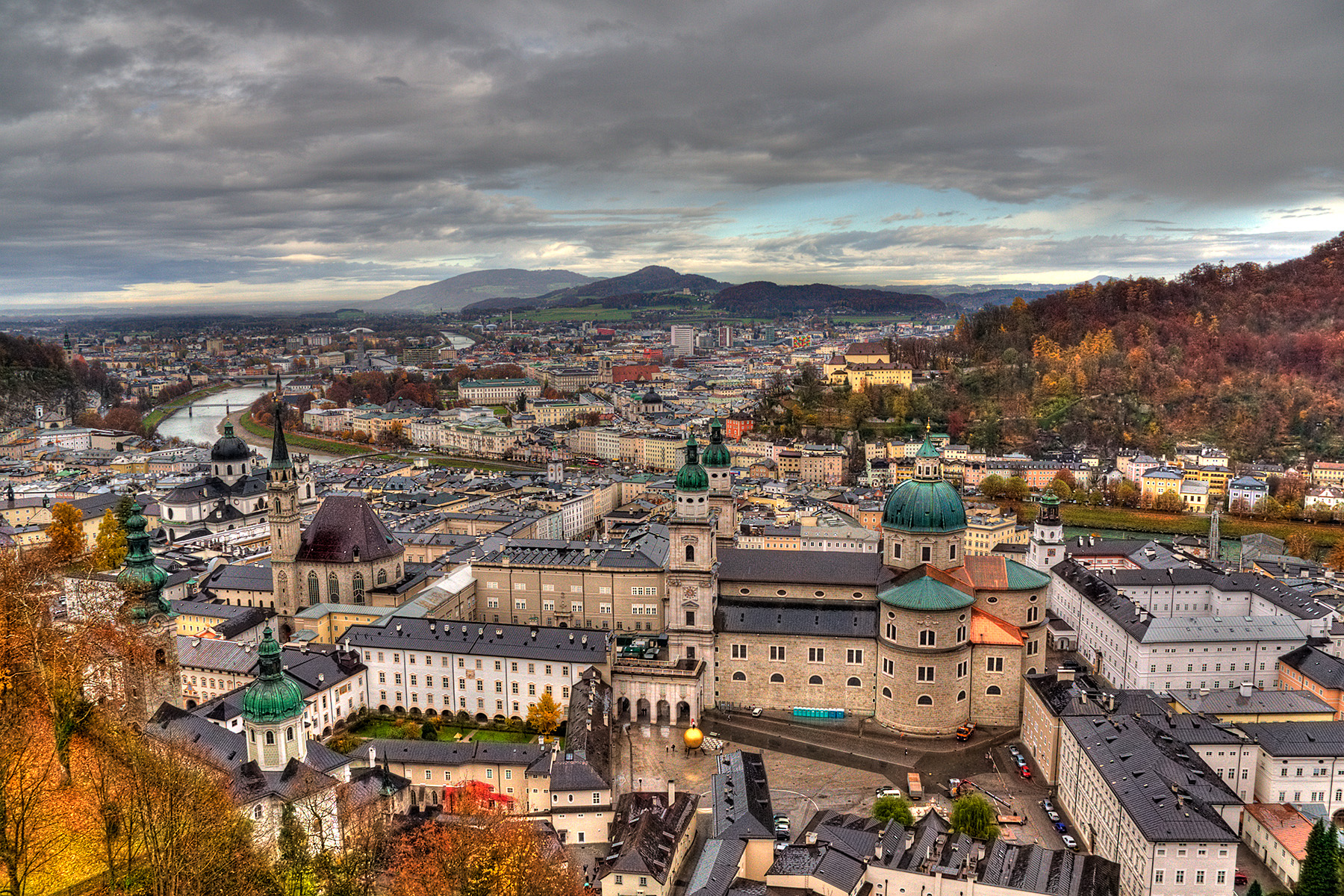
The architectural heart of the centre is formed by Salzburg Cathedral, the Residence, the Franciscan Church and St Peter’s Abbey. Connected by the open space of Domplatz and related courtyards and arcades, these buildings reveal how religious and political authority shaped the town. The cathedral’s symmetrical Baroque façade, monumental dome and sculptural details are designed to be read together with the square before them. The Residence, with its formal halls and courtyards, represents the administrative and ceremonial power of the prince-archbishops. St Peter’s Abbey embodies the older monastic foundation and its continuing influence on the cultural formation of Salzburg. Above this ensemble, the fortress dominates the skyline, while church towers and domes create the distinctive vertical rhythm of the historic centre.
In Getreidegasse, details become especially intimate. Wrought-iron shop signs, decorated doorways, inscriptions, varied façades and through-houses reveal how commerce and architecture were fitted into a narrow medieval street. Number 9 is associated with Wolfgang Amadeus Mozart, who was born there in 1756. His presence gives the centre a particular musical significance, but the connection is also expressed through the churches, squares and historic spaces where Salzburg’s musical life developed. The centre’s universal value comes from the preserved relationship between secular and religious buildings, the meeting of Italian and German cultural traditions, and the survival of an urban landscape formed from the Middle Ages through the nineteenth and twentieth centuries. Notice the contrast between open princely spaces and compact civic lanes, then look upward to the domes, towers, fortress and surrounding hills. Their carefully balanced relationship is the defining visual character of this place.